

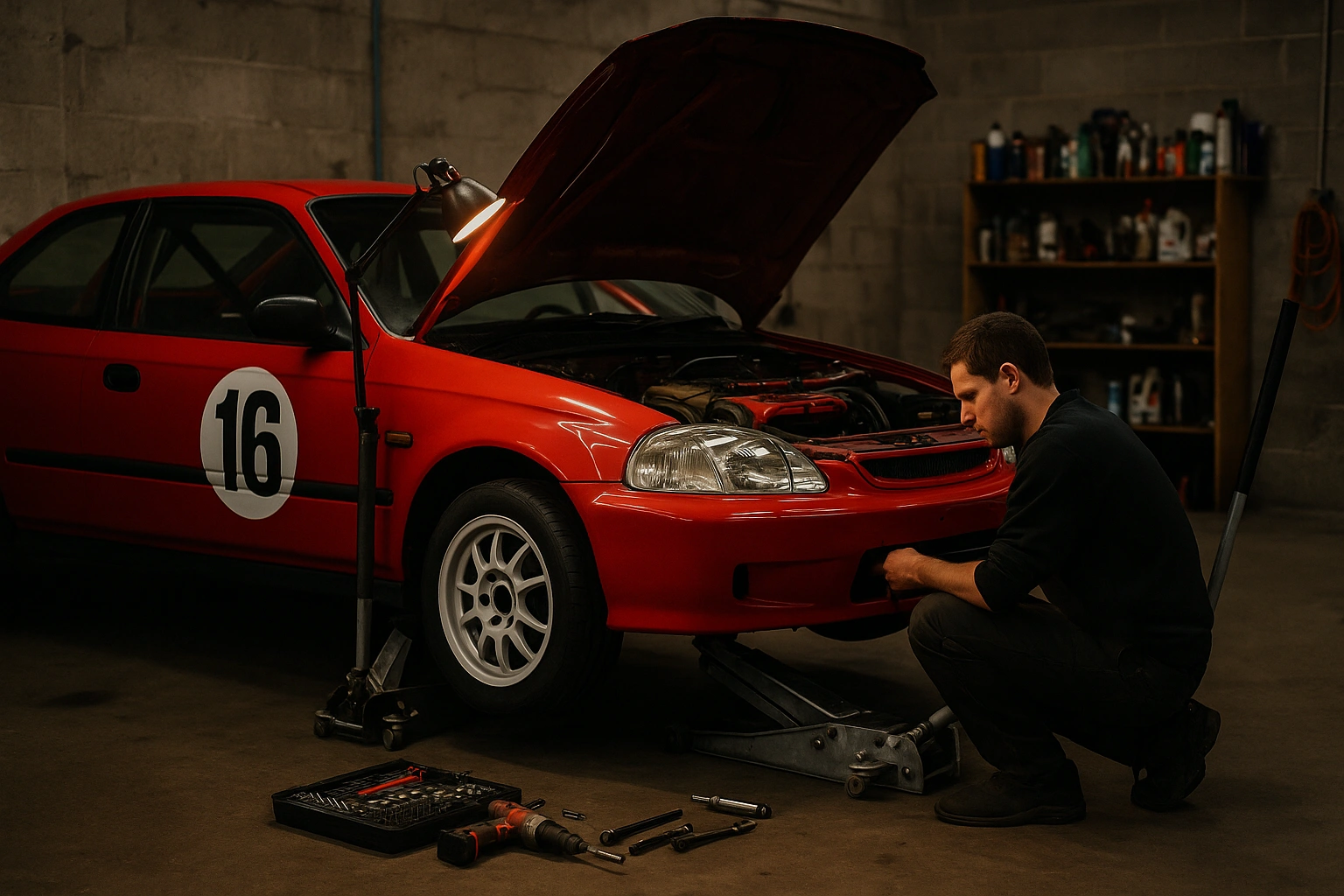
Where Every Race Begins
Before the roar of engines fills the air and the smell of rubber drifts across the circuit, every race begins somewhere much quieter — in the garage. It’s there, under the dim light of a workshop lamp and surrounded by the scent of oil and metal, that the foundations of every racing weekend are built.
For drivers in the Future Classics Championship, the garage is more than just a workspace. It’s a sanctuary, a place where passion meets precision. It’s where evenings stretch into nights and weekends disappear in a blur of tools, torque wrenches, and determination. The transformation from an ordinary road car to a race-ready machine doesn’t happen overnight. It’s a process — part science, part art, and entirely driven by love for the sport.
When the new season approaches, garages across Ireland come alive. Cars are stripped down, inspected, and rebuilt piece by piece. Old parts are replaced, new ones fitted, and the unmistakable sound of engines being tested echoes through quiet neighborhoods. Every competitor knows that races aren’t won on the grid — they’re won here, long before the first lap is even turned.
The Ritual of Preparation
Building and maintaining a race car is a ritual. It begins with planning, because in motorsport, details matter more than dreams. A checklist is made: engine, suspension, brakes, safety equipment, tires, fluids, and all the small components that hold everything together.
The first step is often inspection. Every nut, bolt, and bracket is examined to ensure nothing is fatigued or worn. Racing pushes materials to their limits, and even the smallest weakness can become a costly failure. That’s why seasoned drivers treat maintenance like religion. A single overlooked washer or cracked hose could mean the difference between finishing a race and watching from the sidelines.
Once the basics are confirmed, attention turns to the heart of the car — the engine. It’s stripped, cleaned, and rebuilt with care. Valve clearances are measured to the thousandth of a millimeter, pistons polished, and timing set with precision. In the Future Classics paddock, engines vary wildly — from high-revving 1.6-litre screamers to torquey 2.0-litre workhorses — but each one receives the same devotion.
When the motor finally comes back to life after a rebuild, there’s a collective pause — the kind of silence only broken by the deep, throaty rumble of success. In that sound lies every late night, every scraped knuckle, every hour spent chasing perfection.
Suspension and Setup: Where Handling is Born
A race car is only as good as its handling. Power means little if the driver can’t put it down on the tarmac with confidence. Suspension tuning is where science and intuition collide. It’s about geometry, balance, and understanding how weight moves through the car when it brakes, turns, and accelerates.
In classic racing, there’s no electronic assistance — no computer to analyze grip or adjust damping automatically. Every change must be made by hand, guided by experience. A few millimeters of adjustment in ride height or camber can completely transform how the car feels on track.
Many Future Classics drivers talk about setup like an art form. They’ll spend hours fine-tuning damper settings, experimenting with spring rates, and adjusting tire pressures until the car feels “just right.” There’s no universal formula — every car, track, and driver combination is unique. The secret lies in listening: not just to the car’s noises and vibrations, but to what it’s trying to tell you through the steering wheel and seat.
Even alignment becomes an obsession. The car must track straight, yet turn eagerly. It must grip without snapping, respond without hesitation. Achieving that harmony is part of what makes racing addictive — the pursuit of mechanical balance that borders on perfection.
Safety: The Unsung Hero of Racing
Before any race begins, safety comes first. It’s easy to be captivated by the glamour of speed, but every racer knows that safety equipment is what allows them to chase it fearlessly.
In every Future Classics car, the interior is stripped down to essentials — a sturdy roll cage, a racing seat, and a harness designed to withstand massive forces. Fire extinguishers are mounted within easy reach, and electrical kill switches stand ready for emergencies.
Helmets, suits, and gloves aren’t just formalities; they’re lifelines. They’re designed to resist heat, flame, and impact. For the drivers, suiting up before a race isn’t just about regulation — it’s about respect. Respect for the risks, for the car, and for the sport itself.
There’s a quiet reassurance in these preparations. Every strap fastened, every bolt tightened adds another layer of trust between driver and machine. It’s a pact — “I’ll push you to your limit, and you’ll protect me when things go wrong.”
Tires and Traction
If the engine is the car’s heart, then tires are its feet — the only connection between raw power and the road. Choosing and managing tires is one of the most critical parts of preparation.
Drivers debate endlessly about compounds, pressures, and heat cycles. Too soft, and they wear out before the race ends. Too hard, and they never reach proper grip. Each track demands a different balance. Mondello Park’s smooth asphalt might favor one setup, while Kirkistown’s abrasive surface calls for another.
Tire preparation starts days before the race. They’re cleaned, inspected for wear, and marked for direction. Pressures are set meticulously — not by guesswork, but by data gathered through laps and experience. During the weekend, they’re constantly monitored, adjusted between sessions as temperatures and track conditions change.
There’s poetry in how tires behave. When they’re right, the car glides through corners effortlessly, gripping just enough to let the driver dance at the edge of control. When they’re wrong, every lap becomes a fight. Finding that perfect balance is one of the most satisfying achievements in racing.
The Emotional Build-Up
All the mechanical work — the tuning, the safety checks, the adjustments — builds toward one thing: that first moment when the car rolls out of the garage and onto the trailer.
For many drivers, that moment is almost ceremonial. The straps are secured, the tools are packed, and there’s a quiet pride in seeing the car gleaming under fluorescent light, ready for battle. It’s not just a machine anymore — it’s a reflection of effort, perseverance, and belief.
The journey to the circuit feels like the calm before a storm. The mind runs through mental checklists: Did I torque the wheels correctly? Did I pack the right spares? But beneath the anxiety is a pulse of excitement — the same thrill that keeps racers returning, season after season.
Every bump in the road feels like a countdown to the moment the car’s tires touch the track again. Because when the gates open, and the paddock comes into view, it’s no longer just about preparation — it’s about performance. The countless hours in the garage will soon translate into motion, speed, and maybe even victory.
More Than a Machine
Preparing a race car is about more than mechanics — it’s about connection. The relationship between driver and car is deeply personal, built on trust, patience, and shared experience. A machine that has been torn apart and rebuilt with your own hands carries a special kind of confidence.
When the ignition turns and the engine roars, it’s a heartbeat shared between human and metal. It’s the culmination of every decision, every late night, every mistake and correction. The garage may be where the journey starts, but it’s on the track where it all comes alive.
Because at its core, preparation isn’t just about making a car faster — it’s about giving it soul. And that’s something no amount of technology can replicate.
Arrival at the Circuit
The hum of the road gives way to the unmistakable rhythm of the racetrack long before it comes into view. As the trailer turns off the main road and into the paddock, the senses come alive — the low rumble of engines warming up, the smell of high-octane fuel, the sight of brightly colored liveries glinting in the early light. This is where all the preparation pays off, and every driver feels the same rush of belonging.
Unloading begins almost immediately. Ramps are lowered, straps are released, and for a moment, everyone pauses to take in the sight of their car under open sky. It’s a moment of quiet pride — the transformation from garage to grid is complete. But there’s little time to admire it. Race weekends move fast, and the first task is always setup.
The pit area becomes a hive of activity. Tools are unpacked, tents are raised, and the rhythmic hiss of air guns cuts through the background chatter. Tires are checked once more, fuel levels measured, and everything that was perfect in the garage is rechecked under real conditions. The driver’s mind shifts from builder to competitor.
In the Future Classics paddock, there’s no wall between teams. Everyone helps each other — lending jacks, cables, and advice. It’s not a competition of secrecy, but of shared passion. Someone always has the right wrench, the right wire, or the right word of encouragement. And that’s what makes it feel like a family rather than a battlefield.
The Last-Minute Checks
Just before the first session, the nerves start to show. It’s not fear — it’s anticipation. The hours spent perfecting every bolt and bearing are about to be tested. Drivers perform last-minute rituals: checking mirror angles, strapping on gloves, adjusting belts. Mechanics kneel beside the car, listening to the idle, searching for any sound out of place.
Some drivers talk to their cars before heading out. A pat on the dashboard. A whisper of reassurance. It’s not superstition — it’s connection. They’ve spent weeks together, and in a few minutes, they’ll face the unpredictable reality of the circuit side by side.
Then comes the call to the grid. Helmets go on. The outside world disappears. From inside the cockpit, the world becomes filtered through the hum of the engine and the thrum of adrenaline. The track waits, patient and unforgiving.
The Shakedown
The first laps of the weekend aren’t about speed — they’re about listening. Listening to the car, the surface, the wind. Every vibration, every scent of fuel or brake dust carries information.
The driver eases the car into rhythm, letting the engine breathe, the tires warm, and the nerves settle. The first braking zone reveals whether the balance is right. The first turn shows if the suspension adjustments made in the garage truly translate to grip. The first straight tests the power that was so carefully built weeks before.
Back in the paddock, the debrief begins immediately. Tire temperatures are checked, pressures adjusted, and brake wear inspected. Notes are made on steering response and corner balance. Even if everything feels perfect, there’s always something to refine. Racing is never static — it’s a constant conversation between the car, the driver, and the track.
Adapting to Conditions
No matter how well a car is prepared, the circuit always has its say. Conditions change hour by hour — temperatures rise, winds shift, clouds roll in. What worked in the morning may not work in the afternoon.
That’s when experience becomes priceless. A few clicks softer on the rear dampers, a slight tweak to tire pressure, a different line through Turn 3 — small adjustments that separate a good car from a great one. Future Classics drivers know this dance intimately. Their machines don’t have sensors or data loggers — only feedback from the driver’s senses.
During a race weekend, the garage becomes a workshop once more. Panels are removed, fluids topped up, and small problems solved before they become big ones. The car is alive, and like any living thing, it needs constant care.
There’s a certain poetry to this process. The repetitive tasks — checking torque settings, bleeding brakes, reapplying tape — become meditative. It’s as much about confidence as mechanics. Knowing the car is right lets the driver focus entirely on the next race.
Between Sessions: The Human Side of Preparation
Between runs, the paddock slows down. Engines cool, helmets come off, and the conversations start again. Drivers swap stories about close calls and perfect laps, mechanics share tips, and spectators wander by to admire the craftsmanship up close.
In the Future Classics community, everyone has time for everyone else. A competitor one minute becomes a helper the next. If a car breaks down, a dozen hands appear instantly to push, fix, or lend parts. Someone might pull out a spare alternator, another offers tools, and before long, the engine’s turning again. It’s a display of camaraderie that defines the series.
The shared respect runs deep because everyone knows how much effort goes into getting these cars here. Behind every machine is a story — of long nights, sacrifices, and countless challenges overcome. When you’ve rebuilt an entire car just to race for twenty minutes on a Saturday, you appreciate anyone who’s done the same.
Race Ready
As the day goes on, the car begins to feel settled, as if it remembers what it was built to do. The driver’s confidence grows with each lap, and the garage transforms from a workshop into a launchpad. The final checks are made: fuel topped up, tire pressures set, fluids confirmed, and tools put away. The car is clean, sharp, and ready for its true purpose — the race.
When the driver straps in again, it’s not just about testing mechanics anymore. It’s about trust. The car has been built, tuned, and refined with care. Now, it must perform. The hands that once held wrenches now grip the steering wheel. The same focus that torqued bolts now controls the throttle.
And when the lights go out, every hour spent in the garage suddenly makes sense. The roar of the engine isn’t just power — it’s pride. Every sound, every vibration, every flick of the gear lever is proof that preparation works. The garage fades into memory as the track takes over.
After the Race: Reflection and Renewal
When the checkered flag waves, the adrenaline fades, and the rhythm of the garage returns. The car rolls back in, brakes ticking as they cool, and the driver steps out, helmet under arm, face covered in sweat and satisfaction. Whether the result was victory or survival, there’s always the same moment — a hand on the roof, a silent thank you.
Then comes inspection once more. Fluids checked. Bolts retorqued. Notes taken. The cycle never ends, because racing isn’t about a single weekend — it’s about evolution. Each event teaches something new: a better line, a more efficient tune, a different approach to setup.
And so, the process begins again. Back home, the car is cleaned, stripped, and improved. The smell of race fuel gives way to the quiet hum of fluorescent lights, the scrape of a socket wrench, and the low whine of an engine being tested again. The passion doesn’t fade when the track goes silent — it just moves back into the garage, waiting for the next chapter.
The Eternal Preparation
For those who live this life, the garage is never empty for long. There’s always another race, another project, another goal. The tools don’t rest for long because perfection is never final — it’s always just one more adjustment away.
That’s what keeps the Future Classics spirit alive: the never-ending loop of building, racing, learning, and rebuilding. It’s not about winning trophies or chasing records. It’s about connection — between the driver and the car, the mechanic and the craft, the past and the present.
When a race car returns home, covered in grime and glory, it’s more than a machine. It’s a memory, a teacher, and a promise. The preparation never truly ends — it just transforms. The next race starts the moment the last one finishes, and the cycle continues, fueled by the same passion that started it all.
Because every lap begins long before the start line — in the garage, in the hands of those who believe that a race car isn’t built just to move fast, but to move hearts.