

Beyond Steel and Paint
There’s something unmistakable about a classic race car. It’s not just the roar of an engine or the smell of high-octane fuel — it’s a feeling, a heartbeat that connects man and machine across decades. Each car has a history written in oil stains, chipped paint, and worn steering wheels. They are living artifacts of motorsport’s golden eras, built not for convenience or comfort, but for character.
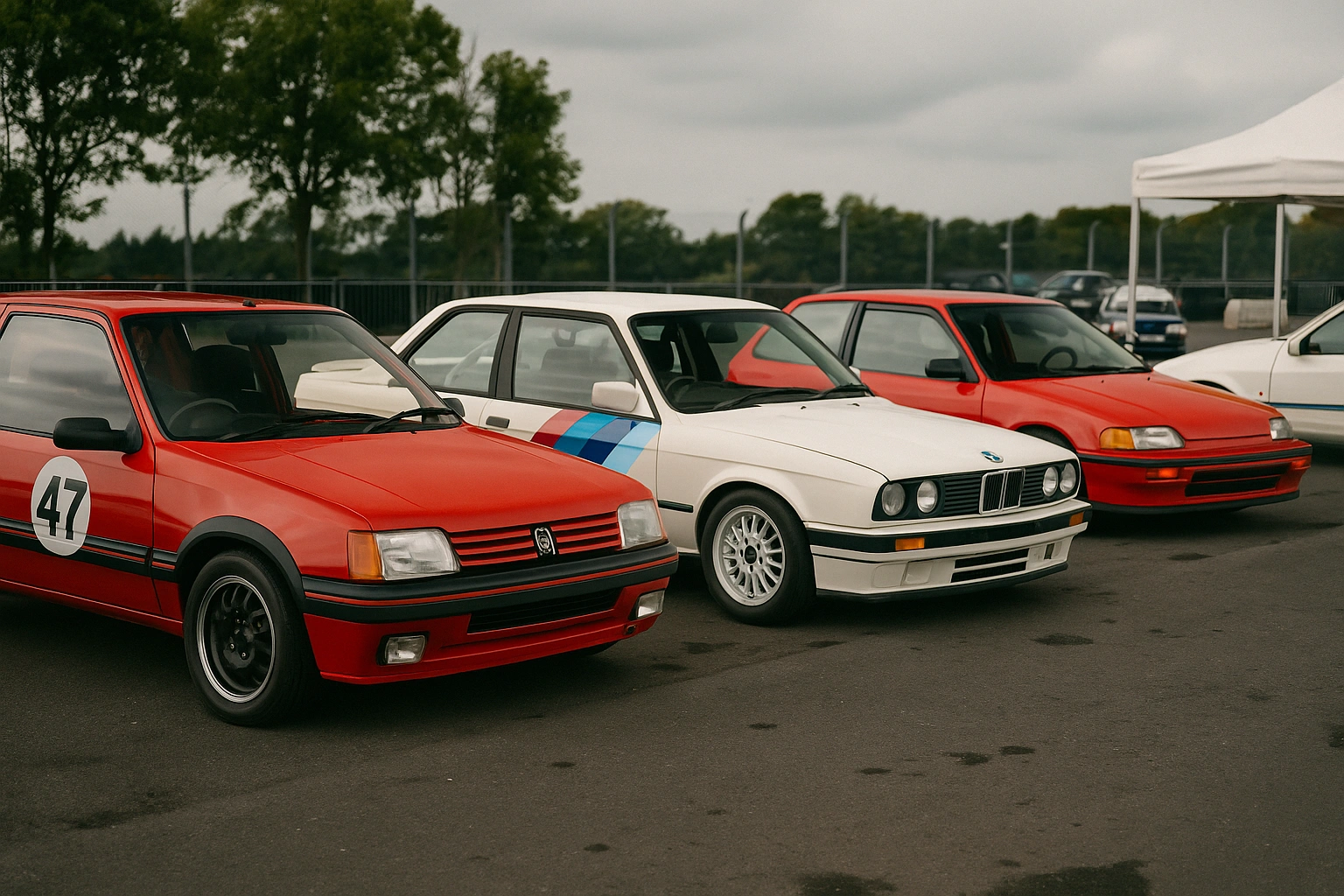
When you walk through the Future Classics paddock on race day, you can sense that magic instantly. Cars from the 1980s and 1990s sit proudly side by side — Peugeots, BMWs, Hondas, Toyotas, Fords — each with its own soul and purpose. The drivers aren’t merely owners; they’re caretakers of history. Every vehicle represents hundreds of hours of labor, patience, and love. What makes them special isn’t just their age — it’s the story they tell every time they fire up.
In a world where modern race cars rely on computers and data, classic racers stand out as mechanical truth. There are no traction controls or digital safety nets — just metal, gasoline, and instinct. Every mistake teaches a lesson, and every lap strengthens the bond between driver and machine.
Built by Hands, Not Algorithms
Modern race cars are designed by software. Aerodynamics are modeled digitally, and engines are tuned by laptops. Classic race cars, by contrast, were built by craftsmen. Every weld, bolt, and adjustment was the result of human judgment — the kind that can’t be automated or simulated.
The beauty of these machines lies in their imperfections. The panel gaps aren’t always even, the gearboxes feel heavy, and sometimes the clutch bites unpredictably. But these quirks are what make them real. They demand respect and understanding. They reward patience and punish arrogance.
Ask any Future Classics driver about their car, and you won’t get a short answer. You’ll hear about the long nights spent sourcing rare parts, the joy of finally tuning the carburetors just right, and the satisfaction of keeping an old machine competitive against newer, faster rivals. These stories are as much a part of racing as the results themselves.
Each car carries fingerprints of its owner’s dedication — a hand-stitched seat cover, a custom bracket, or a home-built exhaust that gives it a distinct growl. That individuality is rare in today’s motorsport, where precision manufacturing and identical setups often make cars indistinguishable. In classic racing, no two cars are ever truly alike.
The Art of Driving Without Assistance
To drive a classic race car fast is to experience motorsport in its purest form. There’s no power steering to hide your mistakes, no traction control to correct them. Every input matters. The steering wheel feels alive, the gearbox resists until you find its rhythm, and the brakes require strength rather than electronics.
It’s a sensory overload — the vibration through the pedals, the smell of burning rubber, the feedback of every bump in the road. But that’s what makes it so addictive. You can’t be passive in a classic race car; you must be completely engaged. The car doesn’t adapt to you — you adapt to it.
At Kirkistown, Mondello Park, and every circuit the Future Classics series visits, you can watch this connection unfold. Drivers don’t simply steer; they communicate. They listen to the engine’s pitch, feel the rear tires’ grip, and predict the limits through instinct. Each corner is a conversation between experience and mechanical truth.
When everything aligns — the tires warm, the balance perfect, the driver in sync — a classic car becomes something transcendent. The lap may not be the fastest by modern standards, but it carries more emotion than any telemetry graph could show.
Emotion in Every Decibel
Classic race cars sound different. They breathe differently. A well-tuned carbureted engine has a pulse that modern engines lack. The growl rises not in sterile precision but in raw, uneven energy — the kind that feels alive.
At any Future Classics weekend, the soundtrack is as important as the racing itself. The sharp bark of a twin-cam Toyota, the burble of a BMW straight-six, the high-pitched wail of a Honda VTEC — each tells its own story. The noise isn’t just mechanical; it’s emotional. It stirs something deep in anyone who’s ever loved motorsport.
Spectators don’t just watch — they feel it. The rumble in their chest as cars roar past, the smell of race fuel in the air, the sight of flames flickering from an exhaust on downshifts. It’s visceral. It’s real. It reminds everyone why racing captured hearts long before it became a commercial spectacle.
For the drivers, sound becomes language. They can tell by ear if the mixture is rich, if the valves are happy, if the engine is on song. It’s a connection modern telemetry can’t replicate — because here, the most important sensor is still the driver’s gut feeling.
A Tribute to Timeless Design
Designing a race car in the 1980s or 1990s wasn’t about marketing aesthetics — it was about form following function. Every curve, every vent, every spoiler had a reason to exist. Yet somehow, these utilitarian designs have become icons of style.
Look at a classic Peugeot 205 GTI or a BMW E30 — their lines are simple, clean, and unmistakably purposeful. There’s no excessive plastic, no overcomplicated aerodynamics, just pure engineering. These cars age gracefully because they were never trying too hard to be fashionable; they were built to perform.
That timelessness extends to their liveries and details. The bright colors, the bold sponsor logos, and the rough textures of vinyl stickers all tell a story of racing’s analog era. In the Future Classics paddock, you can see decades of design evolution lined up side by side — a rolling museum that moves, roars, and breathes.
These cars don’t belong behind ropes in a showroom. They belong on the track, where they can continue writing history lap by lap. Every scrape, every bit of rubber on the fender adds character. They are not fragile antiques — they are living proof that performance and beauty can survive the test of time.
Keeping the Legacy Alive
What truly makes a classic race car special is the community that surrounds it. Future Classics isn’t just about nostalgia; it’s about keeping these machines relevant. Owners invest not just money, but passion — teaching new generations how to maintain carburetors, adjust timing, and respect the limits of mechanical systems.
Young enthusiasts walk through the paddock wide-eyed, fascinated by how different these cars feel compared to modern ones. For them, it’s an education in authenticity. They see that racing doesn’t need carbon fiber or electronic dashboards to be exciting — it just needs commitment and heart.
And that’s why classic racing endures. It bridges generations, unites people from all walks of life, and celebrates engineering that was made to last. Each event, each race, is a tribute not only to the cars but to the people who refuse to let them fade away.
Because when the engines fire and the cars take to the track, something remarkable happens: the past comes alive again. The same machines that thrilled audiences decades ago continue to inspire today. They remind us that passion, not technology, is what truly drives motorsport forward.
The Heart That Never Stops Beating
When a classic race car fires to life, it’s not just starting an engine — it’s awakening history. The sound that follows isn’t polished or digital; it’s raw, imperfect, and alive. You can hear the crankshaft turning, the valves chattering, the exhaust coughing before it clears its throat and roars into song. It’s mechanical art — a heartbeat from another era.
Owners of these cars often speak of them as if they were living creatures. They have moods, quirks, and preferences. A car might start reluctantly on a cold morning but run flawlessly once it warms up. Another might be smooth on one circuit and stubborn on another. These little imperfections are what make classic cars so special — they force the driver to understand, not just operate, the machine.
Every turn of the key, every push of the clutch pedal feels personal. Unlike modern cars, where sensors and software smooth out every experience, classic race cars are brutally honest. If you make a mistake, they’ll let you know immediately. But when you get everything right — the perfect gear shift, the ideal braking point, the balance through a corner — the reward is pure, indescribable satisfaction.
That connection between driver and car is timeless. It’s not measured in horsepower or lap times; it’s measured in smiles, in goosebumps, in the sound of applause from the paddock when an old machine delivers another flawless run.
Engineering That Endures
One of the reasons these cars still race decades later is the brilliance of their engineering. Simplicity, when executed perfectly, endures. In the 1980s and 1990s, engineers didn’t have the same computational tools as today, but they had intuition — an understanding of physics earned through experimentation, not simulation.
That’s why a lightweight, naturally aspirated hatchback from 1989 can still hold its own against newer cars. Its suspension geometry, weight distribution, and mechanical grip were designed by people who tested ideas on the track, not in a lab. These cars were built to be worked on — bolts accessible, wiring straightforward, parts interchangeable. They were never disposable; they were built to last.
Mechanics in the Future Classics paddock talk about these designs with a kind of reverence. They appreciate the purity of an adjustable suspension that responds predictably, the reliability of an engine block that’s still running after 30 years, the durability of gearboxes designed to take a beating. Every nut and bolt tells a story of engineering meant for real humans — not software updates.
There’s beauty in how mechanical everything feels. You can hear gears mesh, feel vibrations through the chassis, and smell the oil as it heats under load. These sensations remind everyone that motorsport used to be physical — not virtual. It was something you could touch, smell, and fight against.
The Stories Written in Metal
Every classic race car carries a story far longer than any championship season. Some of these machines began as daily drivers, then were converted to track cars when their road days ended. Others were purpose-built for competition, passed from one racer to another, each leaving their mark in scratches and modifications.
Walk through a Future Classics paddock, and you can read these stories like chapters. There’s the Civic that’s been rebuilt three times, each version faster than before. The Peugeot that once belonged to a father, now raced by his son. The BMW that’s competed for over two decades and still manages to find podium finishes.
These aren’t just machines — they’re memories on wheels. And that history matters. It connects generations of racers who share the same dream: to keep driving, to keep learning, to keep feeling alive behind the wheel. When spectators stop to look at a car, they’re not just admiring its design — they’re witnessing a legacy that refuses to fade.
Even the smallest detail can tell a story. A sticker from a long-forgotten race, a handwritten note on the dashboard reminding the driver of tire pressures, a patched section of fiberglass from a heroic repair after a spin. Every scar becomes part of its character, proof that the car has lived, not just existed.
The Drivers Who Keep the Flame Alive
Classic racing wouldn’t survive without the people who refuse to let it disappear. These are the enthusiasts who spend their evenings fixing, polishing, and dreaming. They’re engineers, artists, and historians all at once. What unites them is love — love for the cars, for the noise, for the challenge, and for each other.
Future Classics drivers are a unique breed. They race hard, but they also laugh hard. Between sessions, they’ll help a rival fit a new clutch or lend a set of wheels to someone in trouble. They’re competitive but never cold; they know that what truly matters isn’t just crossing the line first, but making sure everyone gets there.
You can feel that spirit in every paddock conversation. Someone will be tuning an engine while another offers advice on suspension settings. Spectators wander freely, welcomed into the mix, invited to touch and ask questions. There are no closed doors, no polished facades — just shared passion.
And that’s why the Future Classics series thrives. It’s not bound by corporate sponsors or broadcast deals; it’s sustained by real people keeping the culture alive. Their dedication ensures that the lessons, sounds, and sensations of classic racing will be passed down to the next generation.
A Celebration of Imperfection
In an era where everything strives for flawless precision, classic race cars remind us that imperfection is beautiful. They don’t always start on the first try. They overheat, misfire, and sometimes demand more patience than sense. But that’s what makes them special. They require involvement, commitment, and humility.
When a driver straps into a 30-year-old race car, there’s no guarantee of a perfect run. But that uncertainty is part of the thrill. Every lap is earned. Every result is deserved. And every victory, no matter how small, feels monumental.
Even spectators sense this truth. Watching a field of Future Classics line up on the grid is like watching a living museum that refuses to stay still. These aren’t relics behind glass; they’re roaring, sliding, and fighting — proving that age doesn’t dull spirit.
Classic racing is a rebellion against disposable culture. It values craft over convenience, skill over software, and passion over perfection. It’s a reminder that machines once had personality — and that the bond between human and machine is strongest when technology steps aside.
Why They Still Matter Today
Classic race cars remind us where motorsport came from — and why it still matters. They show that innovation and tradition don’t have to be enemies. They teach younger drivers mechanical sympathy, patience, and respect for engineering. They connect communities that would otherwise be divided by generations.
When people watch a Future Classics race, they’re witnessing more than competition. They’re seeing an entire philosophy in motion: that authenticity still has a place in a world dominated by technology. That old engines can still inspire awe. That real driving, the kind that leaves your heart pounding and your hands shaking, never goes out of style.
Because a classic race car isn’t defined by its age or value — it’s defined by emotion. By the way it makes you feel when it roars past, when you smell its fuel, when you hear its history. These machines remind us that the soul of racing is not about numbers or fame — it’s about passion, craftsmanship, and the eternal chase for that perfect lap.
And as long as there are people willing to turn wrenches, share stories, and keep these engines running, the legacy of classic race cars will never fade. The spirit that built them still lives — not just in the machines themselves, but in everyone who loves them.
Because what makes a classic race car truly special isn’t the metal, the speed, or the history — it’s the people who keep it alive, one lap, one story, and one heartbeat at a time.